
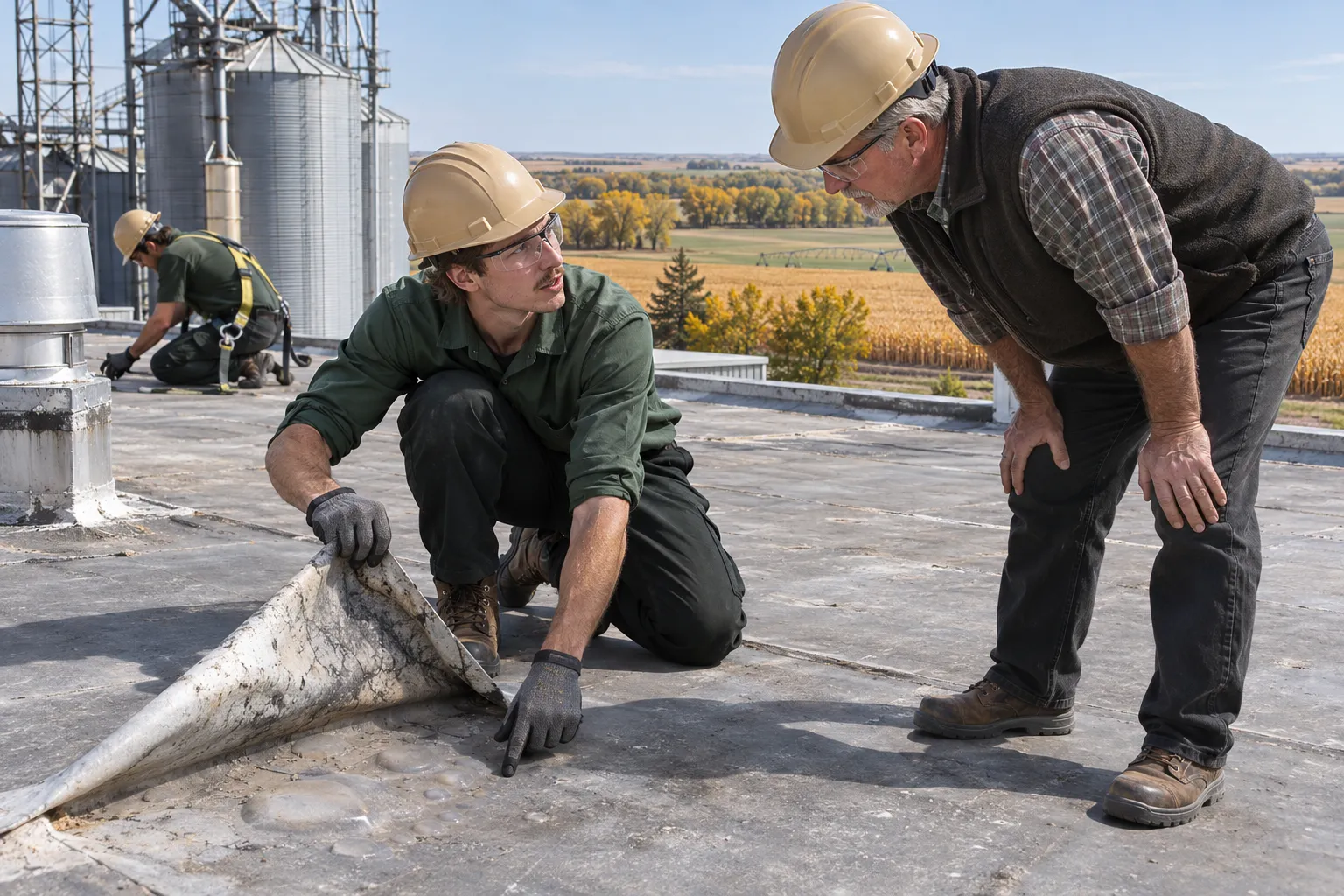
Roofer lifting an old membrane lap while a building owner looks on during a roof walk

Grand Island Commercial Roofing FAQ

Answers on Systems, Cost, Permits, and When to Replace a Roof

Our Grand Island commercial roofing FAQ answers what owners and facility managers ask most, from TPO versus EPDM to building permits.

Grand Island Commercial Roofing FAQ Topics

Jump to a topic below. The Grand Island commercial roofing FAQ groups 31 questions into seven topics, from cost and permits to each roof system and nearby towns.

Commercial Roofing Basics in Grand Island

What drives commercial roof replacement cost in Grand Island?

Commercial roof replacement cost in Grand Island is driven by roof size, the system chosen, and how many layers must come off.

Tear-off of wet insulation, deck repairs, and new insulation add to the total. Parapets, curbs, drains, and rooftop units each need flashing. Crane access, building height, and work around business hours also affect labor.

TPO or EPDM: which fits a Grand Island commercial building?

TPO fits Grand Island commercial buildings that want a white, heat-welded membrane that reflects summer sun. EPDM fits buildings where a flexible black rubber membrane with taped seams suits cold winters and roof movement.

Both work on low-slope roofs. The choice usually comes down to seam method, rooftop traffic, chemical exhaust, and how the roof is attached.

How long does a commercial roof last in Grand Island?

A commercial roof's life in Grand Island depends on the system, installation quality, drainage, and upkeep. Single-ply membranes, metal panels, and built-up roofs each age differently. Hail, freeze-thaw cycles, and ponding near drains shorten service life. Twice-yearly inspections, clear drains, and prompt seam repairs help a roof reach the range its manufacturer rates it for.

What should Grand Island owners compare when choosing commercial roofing companies?

Grand Island owners choosing among commercial roofing companies should compare written scopes line by line. Check the membrane brand and thickness, insulation type and R-value, attachment method, flashing details, and tear-off plan.

Ask who pulls the City of Grand Island building permit. Confirm how rooftop units will be lifted and reset. Clear scopes make bids comparable.

Roof Replacement, Codes, and Permits

When should a Grand Island commercial roof be replaced instead of repaired?

A Grand Island commercial roof is usually ready for replacement when leaks keep returning in new places or the membrane is brittle and shrinking. Wet insulation across large areas is another sign.

An infrared or core-cut survey shows how much insulation is soaked. A roof that already has one recover layer often needs full tear-off. Isolated damage on a sound roof usually calls for repair.

Does a commercial roof replacement in Grand Island need a building permit?

Yes, plan on a building permit for a commercial roof replacement in Grand Island. City Code Section 8-22 requires a separate building permit before a building is altered or repaired.

The city has adopted the 2021 International Building Code, whose Chapter 15 covers roof assemblies and rooftop structures. Confirm the scope with the Grand Island Building Department before tear-off begins.

Which building code applies to reroofing an existing Grand Island building?

Reroofing an existing Grand Island building falls under the city's adopted codes. Those are the 2021 International Building Code and the 2021 International Existing Building Code. Nebraska's state building code, set by Neb.

Rev. Stat. 71-6403, references the 2018 editions of those codes. Grand Island's local adoption is the newer edition. The Grand Island Building Department applies the local code to each permit.

How is a Grand Island commercial roof replacement scheduled around business hours?

A Grand Island commercial roof replacement is scheduled in sections so each day's tear-off is dried in by evening. Crews coordinate crane lifts, dumpster placement, and noisy work around shipping, customer hours, or production shifts.

Rooftop units may need disconnection by the mechanical contractor. Interior protection goes under work areas where dust or debris could fall.

TPO Roofing

What is TPO roofing on a Grand Island commercial building?

TPO roofing on a Grand Island commercial building is a single-ply thermoplastic membrane, usually white, installed over rigid insulation on a low-slope roof.

Seams are joined with hot air that melts the sheets together. TPO is mechanically fastened or fully adhered. The white surface reflects summer sun, which can lower rooftop temperatures over offices and conditioned warehouses.

How does TPO seam welding hold up through Grand Island winters?

Seam welding on TPO creates a fused bond that holds through Grand Island winters when welds are made at the right heat and speed. Crews test-weld sample strips each day and probe finished seams.

Cold weather stiffens the membrane, so welder settings change with temperature. Poor welds show up later as open laps, especially at corners and around curbs.

What drives TPO roofing cost in Grand Island?

Cost for TPO roofing in Grand Island depends on membrane thickness, insulation thickness, attachment method, and tear-off. Thicker membranes cost more upfront. Fully adhered systems take more labor than mechanically fastened ones. Penetrations, curbs, parapet walls, and edge metal add flashing time. Wet insulation found during tear-off and deck repairs are common added items.

Can a TPO roof last 30 years on a Grand Island building?

A TPO roof reaching 30 years on a Grand Island building depends on membrane thickness, weld quality, and maintenance. Thicker membranes give more material to weather away.

Hail, foot traffic around rooftop units, and ponding near drains shorten life. Manufacturers rate TPO systems by thickness and installation spec, so no single lifespan applies to every roof.

EPDM Roofing

Fully adhered or ballasted EPDM: what is the difference on Grand Island roofs?

Fully adhered EPDM on a Grand Island roof is glued to the insulation, giving a smooth surface with good wind resistance. Ballasted EPDM is held down by river rock or pavers, which adds weight but speeds installation.

Ballast requires a structure that can carry the load. Adhered systems are easier to inspect and repair because no stone covers the membrane.

What is the average lifespan of an EPDM roof on a Grand Island building?

An EPDM roof's lifespan on a Grand Island building depends on membrane thickness, seam tape quality, and rooftop traffic. EPDM stays flexible in cold weather, which helps with freeze-thaw cycles.

Seams and flashings are the usual failure points, and the field sheet often outlasts them. Regular seam checks and repairs after hail extend the time before EPDM replacement.

What drives EPDM roofing cost in Grand Island?

EPDM roofing cost in Grand Island depends on membrane thickness, attachment method, insulation, and whether the old roof is torn off. Reinforced EPDM costs more than standard sheet. Fully adhered work uses more adhesive and labor than ballasted work. Large sheets reduce seams on wide roofs, while many penetrations and curbs add detail time.

When does an old EPDM roof in Grand Island need replacement?

An old EPDM roof in Grand Island needs replacement when the membrane has shrunk away from walls or seams fail in many places. Wet insulation below is another sign.

Shrinkage shows as tight, bridged membrane at parapets and curbs. A few seam failures can be repaired. Widespread wet insulation found by a moisture scan usually means tear-off.

Your Question Is About One Specific Roof?

Leak or storm damage

Call and describe the roof.

Want it answered in person

Book a roof walk at your building.

Get A Free Estimate

Industrial Roofing

What roofing systems suit Grand Island manufacturing plants?

Grand Island manufacturing plants commonly use single-ply membranes such as TPO and EPDM, or standing-seam metal, chosen by process exposure. Plants with grease or chemical exhaust need membranes that resist those substances near vents.

Heavy rooftop equipment calls for walkway pads and reinforced curbs. Large spans may need attachment designed for higher wind uplift at corners and edges.

How is an industrial roof replaced at a Grand Island plant without stopping production?

Industrial roof replacement at a Grand Island plant is phased so production lines keep running. Crews tear off and dry in one section at a time, with temporary seals at the end of each day.

Work near air intakes is scheduled to keep fumes out of the building. Areas over sensitive equipment get interior protection and close coordination with plant maintenance.

What should Grand Island plants look for in industrial roofing contractors?

Grand Island plants hiring industrial roofing contractors should look for a written safety plan, rooftop equipment experience, and a clear phasing schedule.

Ask how the crew handles lockout of rooftop units, hot work near combustibles, and crane lifts. Request the membrane, insulation, and attachment specification in writing. Confirm who handles the City of Grand Island permit.

Which industrial roofing materials handle Grand Island hail?

Industrial roofing materials that handle Grand Island hail better include thicker membranes, cover boards over foam insulation, and heavier-gauge metal panels. Cover boards spread impact so insulation does not crush under the membrane.

NWS Hastings reported hail up to tennis ball size within Grand Island on June 13, 2017. Some membranes carry FM or UL hail ratings that owners can compare.

How does snow drifting affect industrial roofs in Grand Island?

Snow drifting affects industrial roofs in Grand Island where wind piles snow against parapets, rooftop units, and lower roof steps. Drifts add concentrated weight that the structure was designed to carry only up to set limits.

Adding equipment or a recover layer changes those loads. A structural review is wise before any change that adds weight or creates new drift areas.

Commercial Metal Roofing

Is metal roofing a good fit for Grand Island agricultural buildings?

Metal roofing fits many Grand Island agricultural buildings, including machine sheds, shops, and storage buildings. Steel panels span purlins with light framing and shed snow and rain well on sloped roofs.

Livestock buildings need panels and fasteners suited to moisture and ammonia. Ventilation and condensation control under the panels matter as much as the panels themselves.

Can metal roofing go over an existing roof on a Grand Island commercial building?

Metal roofing can often go over an existing roof on a Grand Island commercial building using a framing or purlin system. The existing roof must be dry and the structure able to carry the added load.

A recover changes drainage and edge details, so gutters and flashings are redesigned. Grand Island City Code Section 8-22 requires a building permit before a building is altered.

How much is a commercial metal roof in Grand Island, and what sets the price?

The price of a commercial metal roof in Grand Island depends on panel type, gauge, roof area, and roof shape. Standing-seam panels cost more than exposed-fastener panels. Tear-off, new insulation, trim, gutters, and snow retention add to the total. Building height, crane access, and the number of penetrations also change labor time.

What problems do commercial metal roofs face in Grand Island, and how does installation address them?

Commercial metal roofs in Grand Island face snow sliding off eaves, thermal movement, condensation, and oil canning. Installation addresses each one. Snow guards control sliding over doors and walkways.

Floating clips on standing-seam panels let them move with temperature swings. A vapor retarder and ventilation limit condensation. Heavier gauge and a flat substrate reduce oil canning.

Standing seam or exposed fastener: which metal panel fits a Grand Island commercial building?

Standing-seam panels fit Grand Island commercial buildings that want concealed clips, fewer roof penetrations, and use on lower slopes. Exposed-fastener panels fit shops, storage buildings, and machine sheds where a simpler, faster install suits the budget.

Exposed fasteners need periodic checks and replacement over the roof's life. Roof slope, building use, and insulation plans guide the choice.

Nearby Towns

What commercial roofing systems do Aurora, NE businesses usually choose?

Aurora businesses usually choose between TPO, EPDM, and metal roofing based on roof slope and building use. Low-slope retail and office roofs often take TPO or EPDM.

Sloped shops and storage buildings often take standing-seam or exposed-fastener metal. Aurora is within our Grand Island service area, and each roof is inspected before a system is recommended.

What should Central City, NE owners plan for before a commercial reroof?

Central City owners planning a commercial reroof should first confirm permit requirements with the city, since local rules apply. Plan for dumpster placement, crane access, and how tenants or customers will enter during work. Budget time for possible deck repairs found after tear-off. Central City is part of our service area around Grand Island.

What affects commercial roofing cost for St. Paul, NE buildings?

Commercial roofing cost for St. Paul buildings depends on roof size, system type, tear-off layers, insulation, and flashing details.

Smaller roofs often carry a higher cost per square foot because setup and equipment costs spread over less area. Travel time and material delivery are part of the planning. St. Paul is within our Grand Island service area.

Which roofing works for Ord, NE farm supply and grain businesses?

Ord farm supply and grain businesses often use metal roofing on sloped storage and shop buildings. Low-slope offices and retail space often take single-ply membranes.

Grain dust settles on roofs and holds moisture, so drains and gutters need regular cleaning. Ord is part of our service area around Grand Island, and each building is inspected before a system is chosen.

What should Wood River, NE businesses ask about insulation in a new commercial roof?

Wood River businesses replacing a commercial roof should ask about insulation thickness, R-value, and the type of cover board. Ask the building official what insulation the energy code requires for a replacement roof. Tapered insulation can also fix low spots that hold water. Wood River is within our Grand Island service area.

More Grand Island Commercial Roofing FAQ Answers by Phone

If your question is missing here, call and ask, or request an estimate and ask it on the roof.

Call Us (402) 833-7562